
Multi-scale Climate Mitigation Pathways
-
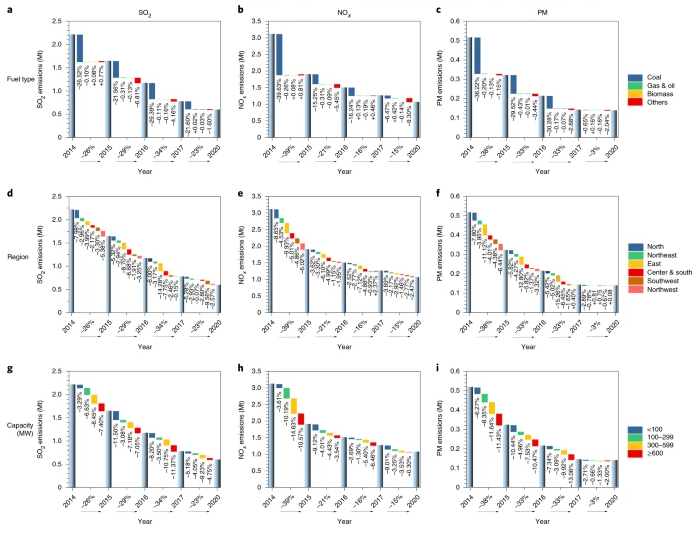
Substantial emission reductions from Chinese power plants after the introduction of ultra-low emissions
In 2014, China introduced an ultra-low emissions (ULE)standards policy for renovating coal-fired power-generating units to limit SO2,NOx and particulate matter (PM) emissions to 35, 50 and 10 mg m−3, respectively. The ULEstandard policy had ambitious levels (surpassing those of all other countries)and implementation timeline. We estimate emission reductions associated withthe ULE policy by constructing a nationwide, unit-level, hou...
-

CEADS Team Publishes Study Revealing That Emissions from Existing Global Energy Infrastructure Threaten
The Intergovernmental Panel on Climate Change (IPCC) released the IPCC Special Report on Global Warming of 1.5°C on October 8, 2018. The report assessed the potential impacts of global warming of 1.5°C and the emission reduction pathways needed to achieve the 1.5°C temperature target. It noted that global temperature has already risen by about 1°C above pre-industrial levels, that global warming of 1.5°C could be reached as early a...
-
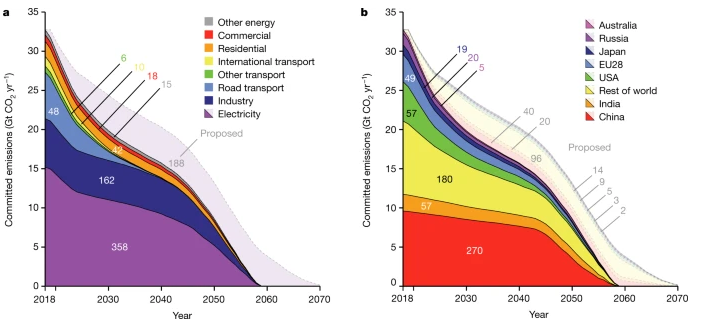
Committed emissions from existing energy infrastructure jeopardize 1.5℃ climate target
Net anthropogenic emissions of carbondioxide (CO2) must approach zero by mid-century (2050) in order to stabilizethe global mean temperature at the level targeted by international efforts. Yetcontinued expansion of fossil-fuel-burning energy infrastructure impliesalready‘committed’future CO2 emissions. Here we use detailed datasets of existingfossil-fuel energy infrastructure in 2018 to estimate regional and sectoralpatterns of comm...
-

CEADs Discusses in Nature That Governments and Enterprises Are Key Vehicles for Achieving the 2020 Glob
As global carbon emissions continue to rise, governments, enterprises and decision-makers have adopted a range of technical measures in emission reduction actions. These measures have received support from climate-change advocates around the world, who are working together to substantially raise climate ambition before 2020. Christiana Figueres, former Executive Secretary of the United Nations Framework Convention on Climate Change (UNF...
-
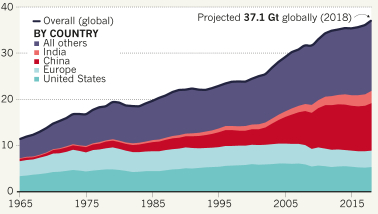
Emissions are still rising: ramp up the cuts
With sources of renewable energy spreading fast, all sectors can do more to decarbonize the world, argue Christiana Figueres and colleagues. Representatives of 190 nations gather this week to review progress at the annual United Nations climate talks. They face a daunting reality: carbon dioxide emissions from fossil fuels are rising again. ...
-
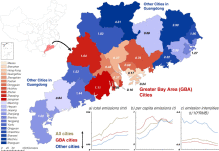
Emissions and low-carbon development in Guangdong-Hong Kong-Macao Greater Bay Area cities and their sur
Cities are the major contributors to energy consumption and CO 2 emissions, as well as being leading innovators and implementers of policy measures in climate change mitigation. Guangdong-Hong Kong-Macao Greater Bay Area (GBA) is an agglomeration of cities put forward by China to strengthen international cooperation among “Belt and Road” countries and promote low-carbon, inclusive, coordinated and sustainable development. Few studies...
-
Energy and carbon intensity: A study on the cross-country industrial shift from China to India and SE A
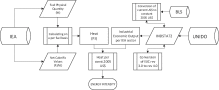
The potential relocation of various industrial sectors from China to India and countries of the SE Asian region presents low cost opportunities for manufacturers, but also risks rising for energy demand and CO 2 emissions. A cross-country shift of industrial output would present challenges for controlling emissions since India and SE Asian countries present higher industrial emissions intensity than China. We find that although there is...
-

CEADs Team Discusses China's Early Carbon Emissions Peak and Its Drivers in Nature Geoscience
As part of the Paris Agreement, China has pledged to peak its carbon dioxide emissions by 2030. As the world's largest carbon emitter, China's carbon emissions trajectory will directly affect global carbon mitigation and global climate change. The CEADs team has long been dedicated to research on carbon emissions in China, developing and freely releasing national, provincial, and city-level emissions inventories. These inventories cover...
-
Structural decline in China’s CO2 emissions through transitions in industry and energy systems
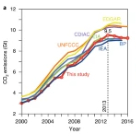
As part of the Paris Agreement, China pledged to peak its CO 2 emissions by 2030. In retrospect, the commitment may have been fulfilled as it was being made—China’s emissions peaked in 2013 at a level of 9.53 gigatons of CO 2 , and have declined in each year from 2014 to 2016. However, the prospect of maintaining the continuance of these reductions depends on the relative contributions of different changes in China. Here, we quantita...
-
The global CO2 emission cost of geographic shifts in international sourcing
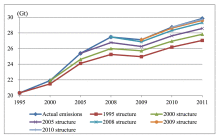
In this paper we simulated the global direct CO 2 emission cost of geographic shift of international sourcing for the period 1995–2011 by comparing the scenarios with and without geographic shift. Our simulations indicate that in 2011, had the share of trade by the sourcing economy remained at the level of 1995, 2000, 2005, and 2008 whereas the global final demand remained the same, global CO 2 emissions in production processes would h...