
CEADs Members Elected to the Council of the International Input-Output Association (IIOA)
Recently, the International Input-Output Association (IIOA) held its Council election. CEADs team members Professor Zhifu Mi and Professor Jing Meng of University College London (UCL) were elected to the IIOA Council, with their terms beginning on January 1, 2024.
Newly Elected Council Members

Professor Zhifu Mi
Professor Mi Zhifu
Zhifu Mi is an executive council member of the Chinese Input-Output Association, a tenured professor, doctoral supervisor, and vice-dean at The Bartlett School of Sustainable Construction, UCL, and a senior visiting scholar at the London School of Economics and Political Science. He has been selected as a Clarivate Highly Cited Researcher and has received honors including the World Sustainability Award, the Chinese Economics Excellent Doctoral Dissertation Award, the China Top 100 Most Influential International Academic Papers Award, the Energy Economics Best Paper Award, the Environmental Research Letters Best Early Career Paper Award, and the Applied Energy Highly Cited Original Paper Award. He serves as Editor-in-Chief of Structural Change and Economic Dynamics (IF=6.1), an SSCI journal. In research, Professor Mi focuses on interdisciplinary studies linking input-output analysis and climate change. His papers based on input-output analysis have been published in economics journals such as Economic Systems Research and Energy Economics, as well as natural science journals including The Lancet, Nature Sustainability, and Environmental Science and Technology. In teaching, Professor Mi offers the master course Input-Output Analysis and Its Applications at UCL and received the 2022 UCL Outstanding Research Supervision Award.

Professor Jing Meng
Professor Meng Jing
Jing Meng is an executive council member of the Chinese Input-Output Association, a tenured professor at The Bartlett School of Sustainable Construction, UCL, and a research fellow at the Centre for Environment, Energy and Natural Resource Governance, University of Cambridge. Dr. Meng received her PhD in Environmental Geography from Peking University in 2016 and has long worked on interdisciplinary research, including climate-change mitigation policy, integrated assessment models driven by low-carbon technology innovation, and the socioeconomic impacts of coordinated emissions reductions. Over the past five years, Dr. Meng has published more than 50 papers as first author and corresponding author, including co-corresponding author, in high-impact journals such as PNAS, Nature Energy, Nature Climate Change, Nature Geoscience, Nature Communications, Nature Sustainability, and One Earth. Dr. Meng was named a Clarivate Highly Cited Researcher in the cross-field category for four consecutive years from 2020 to 2023, and received the 2023 American Geophysical Union (AGU) Global Environmental Change Early Career Award, the 2022 MIT Technology Review Asia Pacific Innovators Under 35 award, the 2020 Future Sustainability Leader Award, the 2018 Nature Communications Top 50 Earth and Planetary Sciences papers recognition, and the 2017 Environmental Research Letters Best Early Career Paper Award. She serves as Executive Editor-in-Chief of Journal of Cleaner Production and Associate Editor of Journal of Geophysical Research: Atmospheres.
Introduction to the International Input-Output Association
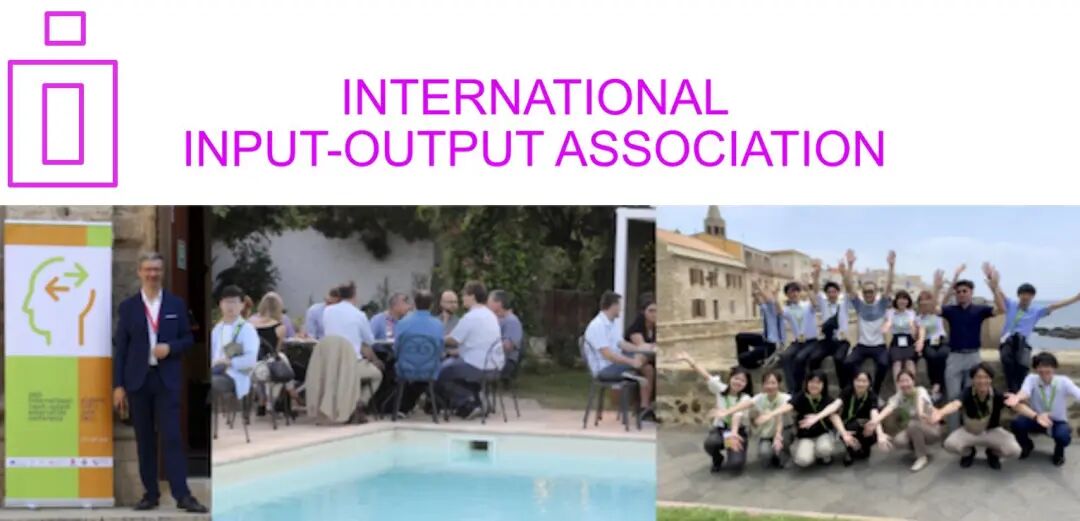
Since its establishment in 1988, the International Input-Output Association (IIOA) has developed into a dynamic, growing, and influential nonprofit scientific organization with members in more than 60 countries. IIOA is committed to advancing knowledge in input-output analysis, covering improvements in foundational data, theoretical innovation and modeling techniques, and diverse applications of input-output methods. To achieve these goals, IIOA continuously supports the development of young scholars, expands its global influence, and promotes the exchange of experience and knowledge through the annual global IIOA conference. In this global community, producers of statistics, such as national statistical offices, come together with a wide range of users, analysts, and policymakers to deepen understanding of key areas including energy, the environment, international trade, financial flows, price analysis, general equilibrium analysis, ecological sustainability, and social well-being.
Economic Systems Research, the official IIOA journal and an SSCI journal, is a rigorously double-blind peer-reviewed scientific journal. It is dedicated to deepening theoretical and practical understanding of economic systems, structures, and processes and how they change over time and space at local, national, and international levels. The journal provides practical and pragmatic tools and data to support modeling, policy analysis, planning, and decision-making in complex economic environments. It promotes understanding and exchange of economic thought across different theoretical schools in the East and West and the Global North and South. Its coverage includes linear and nonlinear multi-sector models of structural change and development, management of ecosystems and exhaustible resources, environmental and strategic issues, databases and data banks, and large-scale computing methods and languages.
Introduction to the International Input-Output Association
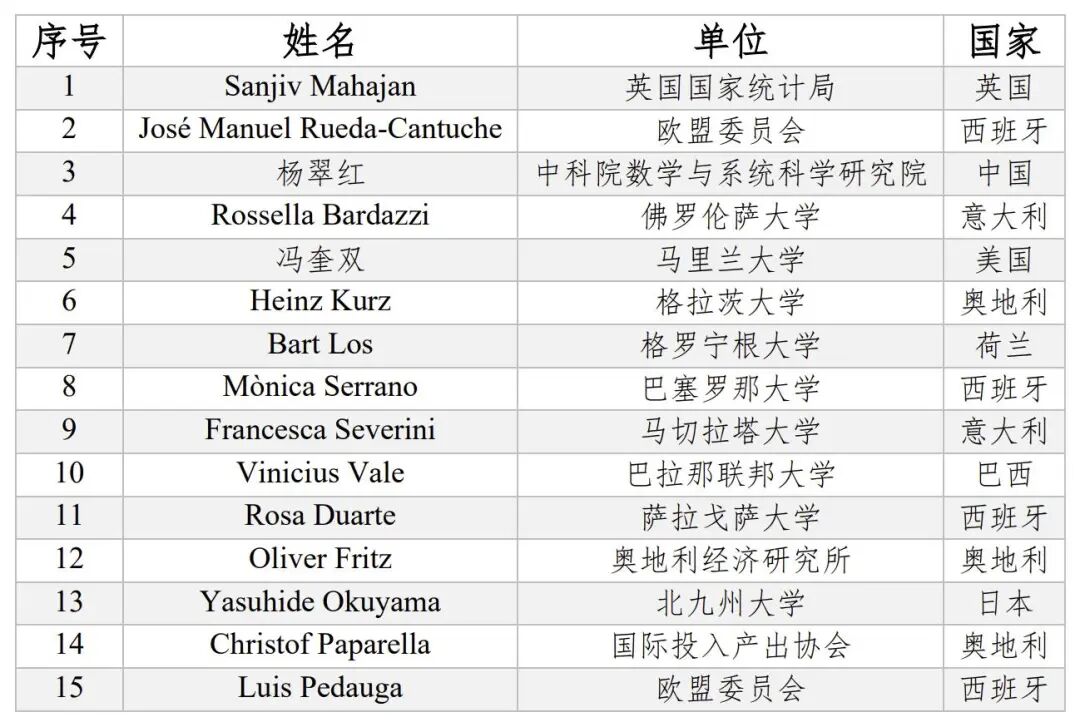
The IIOA Council currently includes 15 members from Spain (4), Austria (3), Italy (2), China, Brazil, Japan, the United States, the United Kingdom, and the Netherlands.
Table 1. Profile of IIOA Council Members
CEADs Contributions to Input-Output Analysis
CEADs has international influence in the field of input-output analysis.
1. In foundational input-output data, CEADs has compiled provincial multi-regional input-output tables for China, city-scale multi-regional input-output tables for China, multi-regional input-output tables for India, and the first global all-region input-output table for emerging economies. CEADs has also compiled multi-scale energy, carbon dioxide, and socioeconomic inventories matched to input-output tables. These data are widely used by scholars, policymakers, and related practitioners.
2. In applications of input-output analysis, CEADs combines input-output analysis with disciplines such as energy, environment, and climate change, making major contributions in areas including carbon footprints, disaster footprints, and global value chains.
National Level
Based on multi-source data fusion, CEADs developed a modular framework for compiling a global all-region input-output model and enabling near-real-time updates. Based on this model framework, CEADs compiled the first global all-region input-output table for emerging economies, covering 245 economies and 135 sectors (EMERGING). The EMERGING model changed the situation in which existing MRIO models worldwide were dominated by Western countries. It is the first near-real-time, global all-region economy-scale input-output model for emerging economies independently developed by Chinese scholars with self-owned intellectual property.
Related Articles:
[1] Huo,et al.(2023), Achieving decent living standards in emerging economies challenges national mitigation goals for CO2 emissions.
Paper link:
https://www.nature.com/articles/s41467-023-42079-8
[2] Huo,et al.(2022), Full-scale, near real-time multi-regional input-output table for the global emerging economies (EMERGING).
Paper link:
https://doi.org/10.1111/jiec.13264
Provincial Level
CEADs has built provincial-level multi-regional input-output tables for countries such as China and India to analyze energy consumption, carbon emissions, environmental pollution, and related issues across regions within a country.
Related Articles:
[1] Huang et al.(2021), Heterogeneity of consumption-based carbon emissions and driving forces in Indian states.
Paper link:
https://www.sciencedirect.com/science/article/pii/S2666792421000317
[2] Mi et al.(2017), Chinese CO2 emission flows have reversed since the global financial crisis.
Paper link:
https://www.nature.com/articles/s41467-017-01820-w
[3] Mi et al.(2018), A multi-regional input-output table mapping China economic outputs and interdependencies in 2012.
Paper link:
https://www.nature.com/articles/sdata2018155
City Level
Based on an entropy model, CEADs developed a framework for compiling city-scale input-output models and compiled multi-regional input-output tables for 309 prefecture-level cities in China.
Related Articles:
[1] Zheng et al.(2023), Leveraging opportunity of low carbon transition by super-emitter cities in China.
Paper link:
https://www.sciencedirect.com/science/article/pii/S2095927323005340
[2] Zheng et al.(2021), Entropy-based Chinese city-level MRIO table framework.
Paper link:
https://www.tandfonline.com/doi/full/10.1080/09535314.2021.1932764
Enterprise Level
At the enterprise level, CEADs proposed a top-down enterprise value-chain carbon footprint accounting method based on input-output life-cycle assessment, effectively improving the comparability of value-chain carbon footprint information for enterprises. Based on this method, CEADs quantified the value-chain carbon footprints of 3,000 listed companies in China. In addition, CEADs used an input-output model that accounts for firm heterogeneity and applied decomposition methods to calculate the carbon footprints associated with the production and operations of foreign-invested enterprises in different countries, while analyzing the main drivers of changes in carbon footprint scale.
Related Articles:
[1] Zhang et al.(2020), Embodied carbon emissions in the supply chains of multinational enterprises.
Paper link:
https://www.nature.com/articles/s41558-020-0895-9
[2] Zhang et al.(2023), Value chain carbon footprints of Chinese listed companies.
Paper link:
https://www.nature.com/articles/s41467-023-38479-5
[3] Wang J, Guan D, Zhang Z, et al. Carbon footprints of the equity portfolios of Chinese fund firms[J]. Communications Earth & Environment, 2023, 4(1): 296.
Paper link:
https://link.springer.com/article/10.1038/s43247-023-00926-y
https://www.nature.com/articles/sdata2018155